
Local Bison Farm Keeps a Western New York Tradition Moving
Local Bison Farm Keeps a Western New York Tradition Moving
Steffenhagen Farms’ annual fall roundup helps keep its herd healthy while continuing a bison-raising tradition that dates back to the 1980s in the Ellicottville area.
From South Dakota’s Custer State Park to the Great Plains of Nebraska to Steffenhagen Farms in nearby Machias, New York, herds of bison across the country have been on the move for the annual fall roundup. Tim Steffenhagen, owner of Steffenhagen Farms, which raises grass-fed elk and bison, shared what this process looks like and the critical purpose it serves in maintaining the health of the herd. Whether you’ve had the opportunity to see Steffenhagen’s herd on Route 242 or have only seen buffalo emblazoned on a jersey, there is so much to learn and appreciate about these fascinating bovines that continue to be a core part of western New York identity.
Centuries ago, American bison (buffalo) roamed wildly in western New York. In fact, the city of Buffalo and Buffalo Creek were named for their presence, which decreased significantly after European settlement and subsequent over-hunting. In this area, buffalo are probably most recognizable today as part of the logos of multiple Buffalo-area professional and amateur sports teams and many have glimpsed the real deal on Route 242 in Machias. Life at Steffenhagen Farms has been especially busy lately with the recent fall roundup!
“The reason behind it is that we have to treat for parasites and make sure all the animals have ear tags and we have a basic inventory,” Steffenhagen explained. “What happens is that we have to trick them by feeding them in certain pastures, and we have to get them into what we call a ‘capture pasture.’”
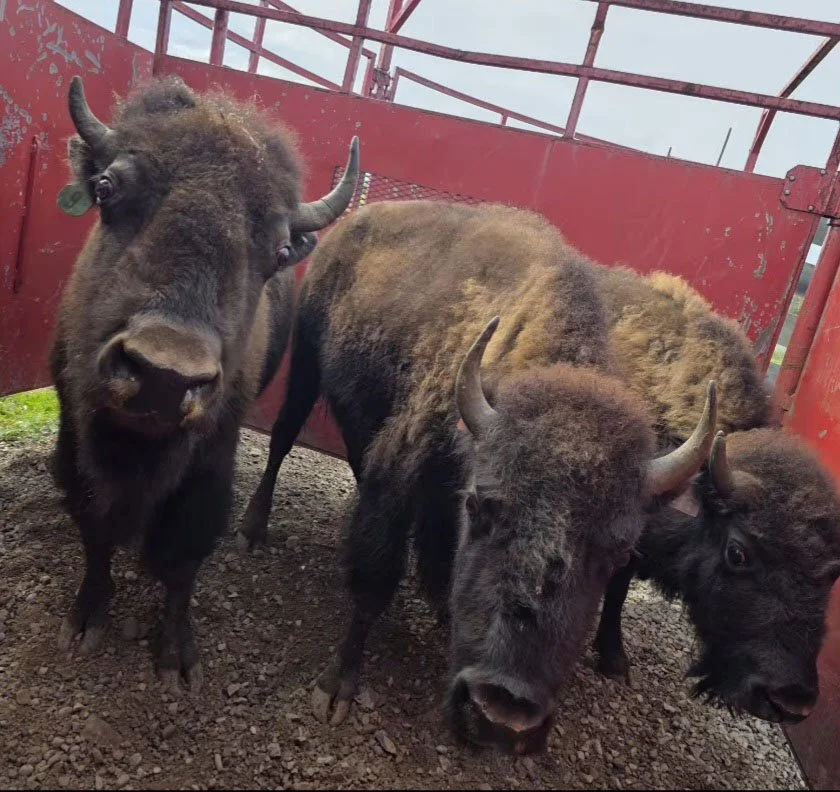
Early in the morning, Steffenhagen and a few others mount four wheelers and circle the herd to move them towards the road. After that, “they’ll go into a bigger corral, and from that bigger corral, we have to move them into a smaller corral.” Once the buffalo are in the small corral, they’re moved into an even smaller corral to get them into a large red tub. “It has a big sweep door that comes around and pushes them into a small alleyway and then into a squeeze chute where we can actually squeeze them and lock their necks so they can’t get us.”
Once they’re locked in, the bison receive two tags - one has a number and a color and the other, a metal tag, is included as a back-up in case the other tag gets lost. After the buffalo are tagged, “we give them shots for parasites because parasites in this area have skyrocketed in the last probably 25 to 30 years, where they never used to be in this area.” Steffenhagen noted that warmer weather and different animals that have been brought to the area throughout the last century have likely contributed to the increase in parasites.
Steffenhagen said every fall, every bison rancher does this process, and he’s been doing this with his herd, which now numbers 86, for many years. “The original bison ranch started in the mid-1980s in Ellicottville, up on Horn Hill,” he explained. “The people wanted to get out of the bison business, and we took it over in 1998.”
Steffenhagen moved the bison to his family’s farm about 10 miles away in Machias. “I’m a fourth generation dairy farmer,” Steffenhagen added. “The farm has been in our family up here at 4141 Route 242 since 1869… a lot of them go for breeding stock. We’ve stocked a couple farms this year already with them, and the bulls generally go for meat.” He explained that some of his buffalo are sold to Maple Ridge Farm in the Hinsdale area, and they sell their meat in downtown Ellicottville.
While the annual fall bison round-up (and the spring elk round-up) requires around 20 people helping Steffenhagen, the rest of the time, he works solo, in addition to having another job. Although his background is in dairy farming, “I like wild animals,” Steffenhagen explained. “I started out raising ducks, and I got into wild ducks… so that kind of was natural to go to buffalo and elk.”
Unlike the beef market, which is characterized by steep highs and lows, he said the price for buffalo is fairly steady; this year, markets for bison opened in Europe, so demand is increasing. Demand for elk may be increasing, too, as Steffenhagen has been involved in conversations about stocking elk in New York, possibly in the Adirondacks and in the lower area of Allegany State Park.
Although Steffenhagen’s farm does not have “open hours,” he invites anyone and everyone to take a drive to 4414 Route 242 in Machias to see them from the road. “We’ve had people from China, Holland, Hawaii, Alaska - you name it - they’ve been here,” he said. “You can see them right from the road. The buffalo usually don’t come out until the evening, but the elk are right there.”