
A Career of Commitment: Trooper Robert Sawicki Retires After 37 Years with the New York State Police
A Career of Commitment: Trooper Robert Sawicki Retires After 37 Years with the New York State Police
From academy graduate in 1989 to the most senior Trooper in Troop A, Sawicki’s career reflects decades of service, mentorship, and quiet dedication.
Throughout my entire life, my uncle’s career with the New York State Police has been a constant presence. By the time I was born, he had already navigated long drives to the academy, endured grueling patrol shifts, and adjusted to an ever-changing job that would eventually span 37 years of service.
What became clear over time is that his career was never defined by rank, seniority, or titles. It was defined by steadiness - showing up again and again through snowstorms, long hours, missed birthdays, and the quiet demands of the job, without ever making it about himself. That consistency carried him from graduating the academy in 1989 to retiring as the #1 Trooper in seniority in Troop A and one of the most senior in the entire state. But to those who know him best, his legacy isn’t measured in numbers. It’s measured in the people he stood beside, the communities he served, and the family who made it all possible. That is the legacy of Robert Sawicki - so buckle up (click it or ticket, as they say), because he’s helped keep the road of justice safe every day of his career.
Let’s rewind to where it all began in 1988. Robert had just graduated from Erie Community College with an associate degree in criminal justice. At the time, he was interested in becoming a police officer so he took the entrance exams for the Erie County Sheriff’s Department, Lackawanna Police Department, and the New York State Police. He passed all three, and was placed on their respective lists, but it was the first call from the State Police that would set him on a path spanning nearly four decades.
The New York State Police Academy in Albany was intense, both physically and mentally. “The thing I remember most about the academy is the amount of physical and academic work I did in those six months. That was definitely the hardest thing I’ve ever done,” Robert recalled. He spent five hours each way commuting on weekends, living at the academy Sunday night through Friday evening. Over the course of more than 1,000 hours of training, recruits faced daily physical conditioning and fitness testing, tactical and defensive skills, firearms instruction, and extensive academic work on laws, procedures, and professional standards. The high-pressure environment tested endurance, focus, and discipline, preparing them for the realities of life as a State Trooper.
After graduating from the academy in 1989, Robert was eager to begin his career. His first assignment brought him to SP Massena in Troop B. After several years there, he transferred closer to home in 1991 and was assigned to SP Williamson in Troop E. In 1993, he returned to Troop A at SP Olean, followed by a transfer to SP Ellicottville in 1995.
“I worked in some very busy stations my first four years and learned a lot about both criminal and vehicle and traffic laws in a short period of time,” he recalled. “I really enjoyed patrol work and thought I would do it for the rest of my career.” Those early years were filled with criminal arrests, DWI and traffic enforcement, accident investigations, and complaint work - experiences that brought him satisfaction knowing he was helping keep the public safe. “I met some great people and we worked side by side, backing each other up and helping each other without hesitation along the way. I remain friends with them to this day.”
As the years went on, his career evolved in ways he hadn’t imagined. He became a breath test instructor at the academy, teaching new recruit Troopers. In 1999, he was assigned Troop A’s School and Community Outreach Coordinator, being the first ever Trooper in this newly created position. Though this was a headquarters position out of SP Batavia, he was able to maintain his office at SP Ellicottville. In this role, Robert worked closely with school districts and community organizations, conducting safety presentations and staff development training. He also had the opportunity to develop and implement the very first School Resource Officer program for the State Police. “I found this work very rewarding and loved doing it,” he said.
Jump to 2004, and Robert was promoted to Investigator and assigned to the Gaming Detail at the Seneca Allegany Casino. This new role marked the beginning of the longest chapter of his service, spanning 22 years and culminating in a promotion to Senior Investigator in 2016. Much of this time was spent in the Bureau of Criminal Investigation (BCI), where his work shifted away from daily public interaction and focused more on due diligence and administrative responsibilities tied to State Police initiatives. While he wasn’t out in the field as much, he still found the role rewarding in its own way.
More than three decades on the job brought many changes to the world of policing, most noticeably in technology and equipment. Trooper grads in 1989 were issued a .357 revolver sidearm, a wooden baton, a plastic flashlight, and a long orange PVC raincoat. Reports were typed on a manual typewriter, and forms and traffic tickets were completed on multi-page carbon-copy sheets. Daily activity at the end of shifts would be handwritten on a large blotter. Today’s Troopers carry a 9mm semi-automatic sidearm, pepper spray, a taser, aluminum flashlights, portable radios, a collapsible baton, and wear Gore-Tex jackets. Reports and tickets are completed digitally, often from mobile terminals in patrol vehicles, and body-worn cameras document interactions with the public.
But just because technology changes, doesn't mean that the core of policing does. Ethics, integrity, and professionalism remain the foundation of every Trooper’s work. Even as the academy has adapted to new technology, laws, and procedures, its staff has continued to instill the core traditions of the State Police - emphasizing a professional demeanor, disciplined approach, and commitment to integrity. Those values remain a constant throughout the years.
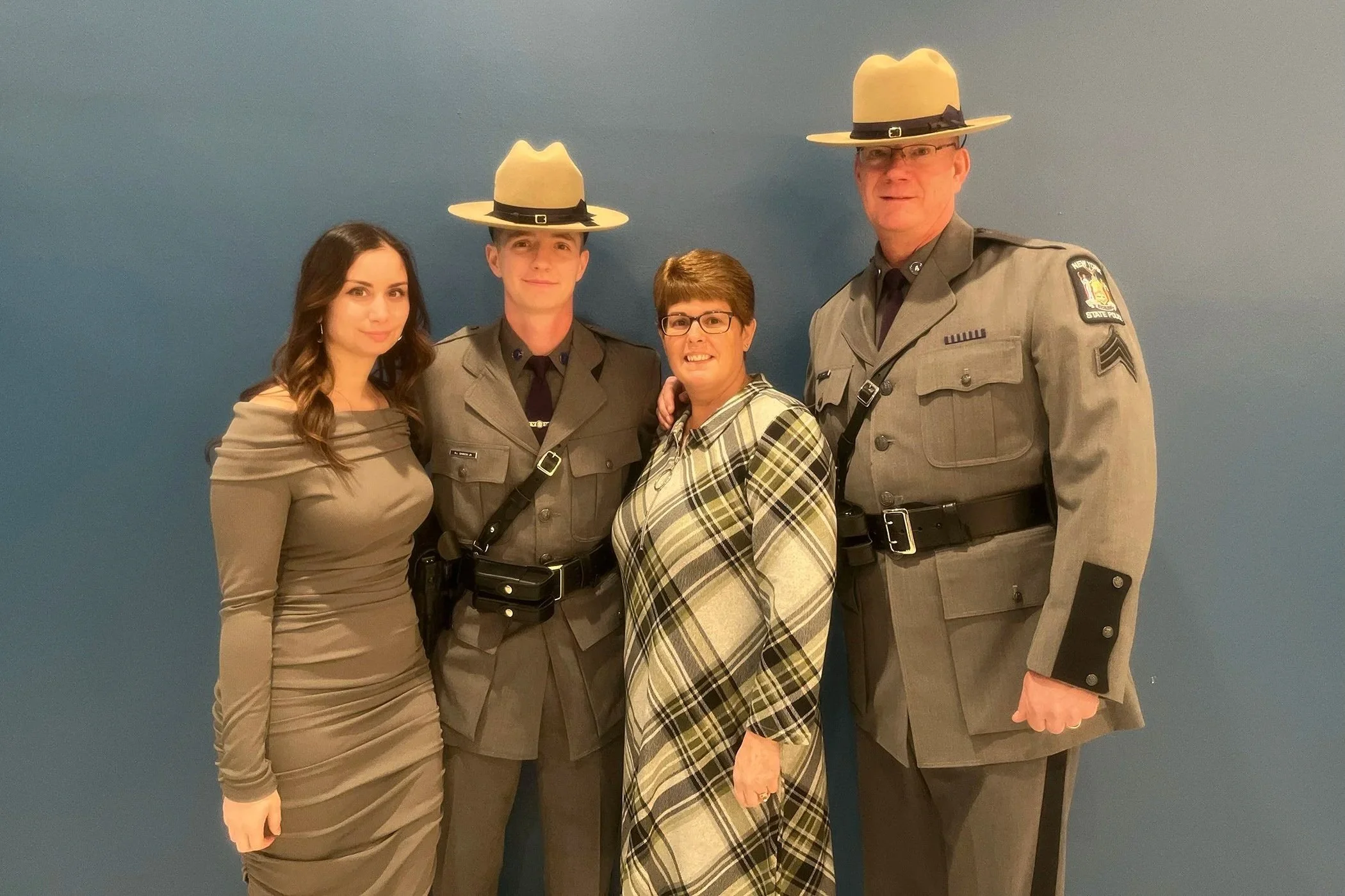
When asked what moments best define his career, Robert points to different chapters. His early patrol years brought pride through enforcement and teamwork. The middle of his career brought fulfillment through teaching, mentorship, and community work. Later years focused on leadership, responsibility, and institutional contributions. But his proudest moment by far was seeing his son, Robert Jr., graduate from the State Police Academy in 2023. “I was able to stand side by side with him in our uniforms and it was an awesome experience. I know how hard he worked to get there. I also turned my shield (2463) over to him at the shield ceremony, which was a great honor. I’m very proud of him,” he shared. And as for Robert Jr., he recalls his dad giving him his shield the greatest feeling in the world.
Another defining moment grew from his son’s academy training. Recruits are assigned a “Silent Partner” - this is the name of a fallen Trooper from the State Police “Wall of Honor,” which includes all the Troopers in State Police history that gave their lives in the line of duty. They are given a card with the Trooper’s picture and information which they carry throughout their career as their silent partner. Another part of the recruit’s academy process is doing an act of commemoration in memory of their silent partner. Robert Jr. was assigned Trooper Joseph Mecca - someone Robert Sr. had worked with and considered a friend. Joe passed away from cancer as a result of his assignment in New York City following the 9/11 attacks. What started as a bronze plaque memorial project grew into a memorial site at SP Olean dedicated to Troopers Joseph Mecca and Ross Riley, who lost his life during a training accident at Letchworth State Park. The site was completed and dedicated in October 2024.
Robert also took pride in helping plan and open the new SP Great Valley station, after Major Eugene Staniszewski asked him to assist in finding a new location to replace SP Ellicottville. He met with Supervisor Dan Brown of Great Valley, and at the time, they were in the process of building a new addition to the Great Valley Town Hall and were more than happy to work with the State Police.
Fast forward to January 2026 and it’s time for Robert to retire. By this time, he was #1 in seniority in Troop A and #3 in the entire state. Seniority was never the goal, but it became a source of pride. “I always though I’d retire at 50… Life sort of dictated my career along the way. When Robert Jr. decided to become a Trooper, I though it would be cool if I could still be working and attend the graduation in uniform,” he recalled. After Robert Jr. graduated, Robert experienced the job in a new way. Working alongside his son and fielding calls from him during shifts brought him back to his own early days as a Trooper. Somewhere along the way, it also became clear that his time on the job had quietly added up. The younger Troopers noticed too, and he took plenty of hits about his age and time on the job - they even went as far as to ask what his first horse’s name was (whoever you are, I just want to talk).
Not everyone lasts as long as Robert did, and for plenty of understandable reasons. He’s glad he stuck around. Family encouragement helped - especially from his wife Missy, who jokingly told him he wasn’t allowed to retire until he cracked the top five in seniority. And he made it! More than anything, he’s tried to pass that perspective on to the younger Troopers he meets: experience takes time to build, and it’s just as long to replace once it’s gone.
But longevity in this profession doesn’t happen by accident. It comes with trade-offs. Police work doesn’t pause for anyone or anything - not for birthday parties, baseball games, or concerts. It’s a 24/7/365 commitment through days, nights, weekends, and holidays. That reality comes with the territory, and every officer will tell you the job has a way of bleeding into personal life. Over time, you learn to accept it. Sometimes you’re able to move into roles with a more manageable schedule. Sometimes you aren’t.
Through it all, Robert is quick to point to the person who made it all possible - his wife. Missy has been his biggest supporter from the beginning (and even before he started this career path), keeping their family life steady through rooting shifts and long nights. “I always say she’s the best secretary in the world… and I’m glad she’s mine! I’d be lost without her. A strong supportive significant other means everything,” he shared. But Missy wasn’t the only one who helped carry the weight of the job. Robert often says that both she and Robert Jr. kept him grounded outside of work. A full personal life created a necessary separation from what he encountered on duty.
Because police work has a side most people never see. Over the years, he responded to horrific accidents, homicides, suicides, child abuse cases, and violent domestic incidents - scenes that are difficult to process, especially as a young Trooper just starting out. In those moments, there isn’t time to dwell. You focus on the task in front of you. You do the job. Then you go home, wake up the next morning, and report back in - trying to leave the images and sounds of the night before behind you. That’s the reality of the profession.
Through those heavier seasons, Robert leaned on his faith. It became a steady source of strength during the darker moments of the job - something he believes helped him endure what otherwise would have been difficult to carry alone.
That perspective shaped the way he views the next generation, including his own son. Watching Robert Jr. step into the same uniform was a full-circle moment. People often ask how he feels about his son becoming a Trooper in today’s world. His answer is simple: It’s no different than when he started in 1989. The world was changing then too. Senior Troopers even asked him the same question early in his career.
Robert Jr. grew up in the version of the world he now polices. It’s what he knows. The academy prepared him with the training, judgement, and tools to do the job safely and professionally, and Robert Sr. has faith in that process. He trusts that foundation his son received and believes he’ll carry those lessons into the field. But doing it all again for him would be difficult - not because the job isn’t worth it, but because he knows what it was like before.
After 37 years, the numbers are easy to list - assignments, promotions, seniority rankings - but that’s not what comes to mind first. “The people I met along the way are what I’ll remember the most,” Robert said. “The ones I worked with, the ones I helped, the ones that helped me, the ones I taught, the ones that taught me… and the ones I lost. They all have a special place in my heart.” Careers are often measured in productivity or accomplishments, but for him, success was simpler. “I think the best way to calculate a successful career is the amount of people you made a difference with. After all… that’s our job.”
Leadership, he says, began in the academy and developed steadily over time. With seniority came responsibility - mentoring younger Troopers and Investigators, guiding them through the early years he remembered so clearly. Those lessons carried beyond the uniform and into his personal life, especially while coaching youth and high school sports.
That leadership did not go unnoticed. Lieutenant Mike Connors, from the BCI, reflected on Robert’s time overseeing the Casino detail: “He ran the Casino flawlessly. I think anybody that’s worked with him - the members that are there now and the members that have gone through there - would say the same thing. It’s a long time to do this job. He’s done it with class, professionalism, integrity. We would take a whole troop of Senior Investigator Sawickis if we could.”
Looking back, he says the job taught him something about himself, too. “From the six months in the academy through those 37 years, I was tested in many ways and made it through. It wasn’t always pretty or without mistakes, but I made it through.”
As he steps into retirement, what he says he’ll miss most isn’t the title or the authority - it’s the people. “I’ll miss the daily interaction with everyone I worked with, including Robert Jr.,” he said. At the same time, he’s looking forward to new routines, meeting new people, and, as he jokes, tackling the long list of projects waiting for him at home. More than anything, he hopes he’ll be remembered as someone who came to work and did the job - without complaining - and did it to the best of his ability.
For Robert Jr., much of what his father accomplished was never fully visible growing up. “My dad never talked much about work with me,” he said. “But when his bosses brought up all of his accomplishments at his retirement ceremony, I finally got to hear all of the proof that my dad was really the superhero I always believed him to be when I was growing up.”
And maybe that says more than any statistic ever could.