
WNY Native David Montesanti Completes Boston Marathon and Summits Mount Everest in the Same Year
WNY Native David Montesanti Completes Boston Marathon and Summits Mount Everest in the Same Year
Ophthalmologist, marathon runner, and mountaineer David Montesanti shares the incredible journey of qualifying for the Boston Marathon, recovering from a concussion, and reaching the summit of Mount Everest just weeks apart.
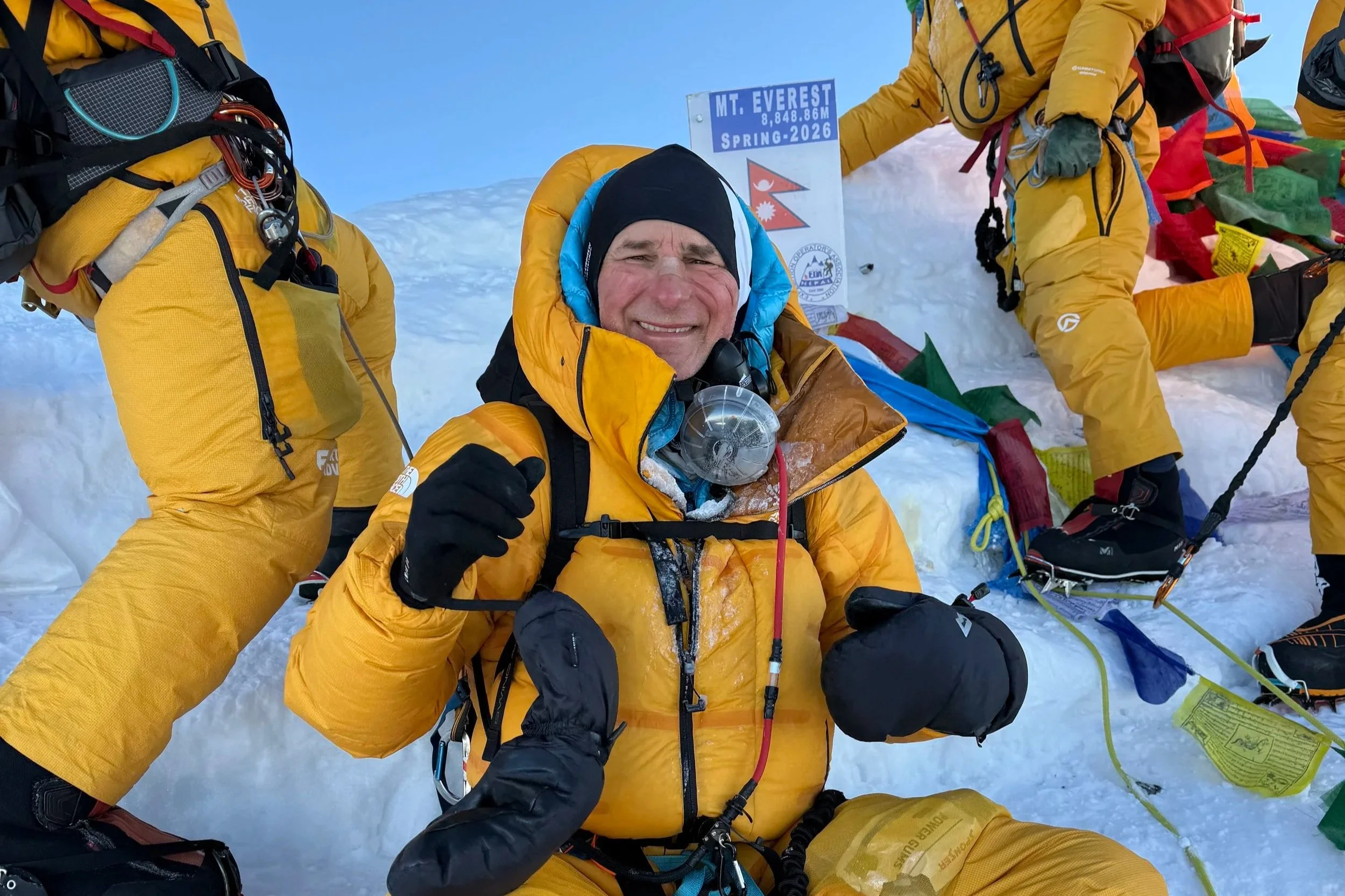
Some of us have goals, and some of us have, well, goals of a higher elevation. Such is the case with Western New York native David Montesanti, ophthalmologist by day and mountaineer by weekend. In a once-in-a-lifetime feat never achieved before, Montesanti ran the Boston Marathon earlier this year at a pace that qualified him for next year’s, and then, just one week later, boarded a plane for a trip around the world to Katmandu, where he met a group of climbers to begin a four-week stretch that resulted in his summiting the world’s highest peak, Mount Everest. EllicottvilleNOW caught up with David for an in-depth discussion of how he managed to do both.
“That is some quirky twist in the space-time continuum there, because apparently no one’s ever done that,” said Montesanti on a phone interview, inferencing his recent accomplishments. He shared that a junior high school teacher once said that no one in his class would ever climb Everest, but they could do other great things. “That kind of stuck back then, and I said, ‘oh yeah – maybe I will climb Mount Everest,’” David recounted, adding that the teacher’s words have stayed with him since the ‘70s.
Always having a strong affinity for the outdoors, Montesanti said that his passion for mountaineering grew when he met his wife who comes from an active climbing family. “My wife and her family are climbers and hikers, and she got me hiking the Adirondacks,” he shared. “She is a very good climber, and we did a couple of mountains together, like Kilimanjaro.” Not only is Kilimanjaro on the list, Montesanti has also climbed such notable peaks as Denali (now Mount McKinley) in Alaska, Aconcagua in Argentina, and Carstensz Pyramid in Indonesia.
“When we climbed Carstensz Pyramid, several of the guys in our group became friends and kept in touch over social media,” he shared. “We said, you know, we all should do Everest together, and I explained my history, and why I wanted to do it, so we made a plan in late 2024 that we would climb Everest this year,” David said. “At the same time, though I have been a runner my whole life, I could never have qualified for the Boston Marathon. When I was younger, the Boston qualifying times were pretty strict, and usually just professionals or hard-core runners could meet those times. I was more a casual runner and would occasionally time myself but wasn’t interested in working to meet those times,” he continued. "But, as I got older, and crossed into new age brackets, the qualifying times became easier to reach. Finally, in August of 2025, my fifth marathon of the year, I qualified for the Boston Marathon,” he shared.
“It turned out that the Boston Marathon was one week before the Everest trip was supposed to happen,” he said, “so I talked to the trainers – we had trainers for the Everest trip to help us train for the year – and I asked, ‘should I do this, should I run the Boston Marathon and then go to Everest? It is two different training programs,’ and they all said the same thing, ‘well of course not – that makes no sense – you are not going to be training for a marathon while you are training for Everest, that is two different types of training,’” he shared. “I thought, well, I guess I have to do it, so I signed up for the Boston Marathon anyway and continued the training for Everest,” he said.
That was not the last time David would be met with resistance to his plan, as a setback on Saddleback Mountain in the Adirondacks last September ended in a concussion. “During my training for Everest, my wife and I did the Great Range, a 25-mile loop from Rooster Comb to Marcy and back,” he continued. “It goes over nine peaks in the Adirondacks, [which is] pretty tough climbing compared to other places I have been in the world. On the back of Saddleback, I fell down a rock face and I got a pretty nasty concussion, so [when] I came back to Buffalo and got treated for the concussion, some of the people at the neurology clinic said, ‘you should not do Everest this year, you should not run this year, why don’t you put it off for a year?’” he said.
“So once again, I listened carefully and ignored them. I said, ‘there is no way that I am putting it off,’ so I trained pretty hard, and got better, the concussion symptoms went away, and on April 20th was the Boston Marathon. “I ran that and did really well, at least for me, so I qualified for next year. A week later, I flew to Kathmandu from Toronto and started the Everest hike, which turned out to be a four-week hike,” David continued.
Training for both events was continual and lasted a full year, entailing aerobic, endurance, elevation, and hypoxia training in order to successfully manage the climb, which David described as taking multiple days, especially during the summit push.
“The summit push is when you go from base camp at 17,500 feet to the summit of Everest, which is at 29,000 feet, so they call it the summit push. It takes five days up and two days down,” he explained. “Over five days, you are doing a vertical elevation of over 12,000 feet, which in that thin air is not easy, so our training was geared towards getting us the ability to do 12,000 vertical feet in a short period of time,” he said. “I did a lot of hiking in other mountains with my wife, Jackie, and we did something called the Rim to Rim to Rim in the Grand Canyon – the South Rim, North Rim, South Rim – a 48-mile trek and 6,000 vertical feet; also, I did something they call the Cactus to Clouds in Palm Springs, and that’s a real long climb, but was not able to do all of that because of the weather at the top. And of course, I did the Great Range, and that’s when I fell in September.”
In addition to climbing Stairmasters with a 60lb backpack and running the treadmill on a vertical incline, Montesanti and his group practiced hypoxia training eight weeks prior to departure as way to pre-acclimatize and adjust their bodies to low-oxygen environments.
“There were ten of us in our group, and each one of us had these hypoxic tents, which are plastic tents that go over a bed, and there is an oxygen generator that will pump oxygen into the tent at a lower percentage than ambient oxygen,” David said. “Oxygen concentration in air is 20.9%, whether in western New York or at the top of Mount Everest, but the .02 partial pressure at the top of Mount Everest is only about one-third of that at home,” David explained. “Since we can’t change the pressure of the air we breathe without a hyperbaric chamber, we mimicked the low air pressure by decreasing the concentration of oxygen in these tents. We got down to a good base of about 10-11 percent to gear our bodies up for the hypoxic conditions on Everest,” he continued.
Because of the many physiological changes that happen in the body in such adverse climates, Montesanti said that nutrition also played a role in preparation for the climb. “Most of us are healthy and good athletes so we eat well anyway, but this was a little different. We had to increase our good healthy fats, decrease any simple sugars, and increase the complex carbohydrates, all while laying down muscle by keeping lean protein going,” he said. “On the mountain, we are going to lose muscle and we all know it – lose weight and lose muscle – and so the goal was to build up muscle knowing that we were going to lose it, especially in our upper bodies.”
People ask him if he is some sort of thrill seeker for having such extreme hobbies. “I am less of a thrill seeker, I more like the camaraderie,” he explained. “The ten guys I was with, or whoever you climb with, share a commonality, a feeling, a goal that does not have to be said aloud. Each of us are 100% focused. You do not think about anything else; you do not do anything else when you are climbing mountains like this, you are completely focused, and you kind of rely on the people around you to be focused as well. When you get to the top and you come back down, the feeling and the intergroup closeness, it is like nothing else,” David shared. “Maybe like family, that is the only thing I can compare it to – that rush, that thrill, it isn’t the climb, it is the post-climb, post-closeness, post-togetherness of the group – and that is something I only get otherwise at home with my family.”
When asked what he would say to the naysayers, David explained that doing extreme activities like climbing Everest and running the Boston Marathon just makes him who he is. “So, the naysayers who say, ‘why risk your life, why put your family through it?’ – that is an argument that maybe I cannot answer, only to say that doing this and coming back makes me part of who I am,” he shared. “If my family loves me for who I am, equally as much as I love them, then doing this is me, and so that is part of what they love. Less putting them through [something], and more growing with them, that sort of thing,” he said.